🚀 AllWDbook — From Idea to Launch
AllWDbook Build Journal
From a Simple Idea to a Real Platform: How AllWDbook Started
A practical look at the early stages of AllWDbook, from identifying the problem to turning the idea into a functioning web platform.
When AllWDbook started, I did not have a complete blueprint for a large platform, and I did not begin with a long list of features that had to be built. The starting point was much simpler: there were several problems I repeatedly faced while working in digital publishing, and I wanted a more organized way to handle them.
At first, the idea was focused on a tool I could use myself. But every time I tried to solve one problem, its connection to another became clearer. An idea leads to niche research, a niche leads to keywords, market research leads to competitors, and later come calculations, cover preparation, and other publishing tasks.
Over time, it became clear that what I was building was no longer a single isolated tool. It was becoming a system that brought several stages of a publisher's workflow into one place.
This is not a story about building a huge product from day one. It is the story of gradually moving from a clear personal problem to a real web platform that other publishers can use.
I started with the problem, not the platform
When thinking about a new project, it is easy to start by asking what the website should look like, which pages it should have, and how many tools should be included. That was not the first question behind AllWDbook.
The first question was simpler: which parts of my publishing workflow were creating the most friction and fragmentation? That immediately pointed to practical tasks such as keyword research, niche exploration, narrowing an idea into a Micro-Niche, studying the market, reviewing competitors, estimating royalties, and preparing correct cover dimensions.
That distinction matters. When a project starts with a feature list, it can easily become a collection of tools without a clear relationship. When it starts with a real problem, every feature has to justify itself by reducing friction or helping the user make a better decision.
So the early goal was not to make AllWDbook contain as many tools as possible. The goal was to make the tasks I repeated as a publisher easier to manage.
A useful first version matters more than a complete first version
Digital projects create a strong temptation to wait until everything feels complete. But a platform does not become useful because it contains everything. It becomes useful when it solves a real problem in a form that people can actually use.
The focus was therefore on getting the core tools working first. The objective was not to build every possible scenario from the beginning, but to make sure a user could open the platform, reach a useful tool, enter relevant information, and receive something that helped with the next step.
This changed the way AllWDbook developed. Instead of trying to build many unrelated pieces at once, each tool could be added around a clear need and then improved after becoming part of the real platform.
A working version also changes how you think. Some problems that appear important on paper become less significant in actual use, while small usability details can turn out to have a much larger impact.
From separate tools to one workflow
As more tools were added, another challenge appeared: simply putting several tools on one website was not enough. If users still felt they were moving between unrelated functions, the original problem had not really been solved.
I began to think of AllWDbook as a journey. A publisher may start with an idea, narrow it into a more specific direction, research related keywords, and then study the market and competition. Later come printing and royalty calculations, cover preparation, and book copy.
These stages are not identical for every publisher, but they are connected. The value of the platform therefore began to come from bringing those stages into one environment rather than simply increasing the number of tools.
That was the point where AllWDbook began to move from a personal utility toward a platform with a clear purpose: digital publishing tools inside one connected experience.
Design became part of the product
Once the core functionality started taking shape, design could no longer be treated as decoration. Useful tools still lose much of their value if reaching them is confusing or tiring.
The interface therefore became tied to real usage questions: how quickly can users reach the tools? How does the information behave on a phone? Are the primary actions obvious? Can the platform maintain one identity while supporting very different functions?
The dark, night-navy and orange visual identity became part of AllWDbook, but consistency mattered more than the colors themselves. A user should still feel that they are inside the same platform when moving from research to royalties or cover preparation.
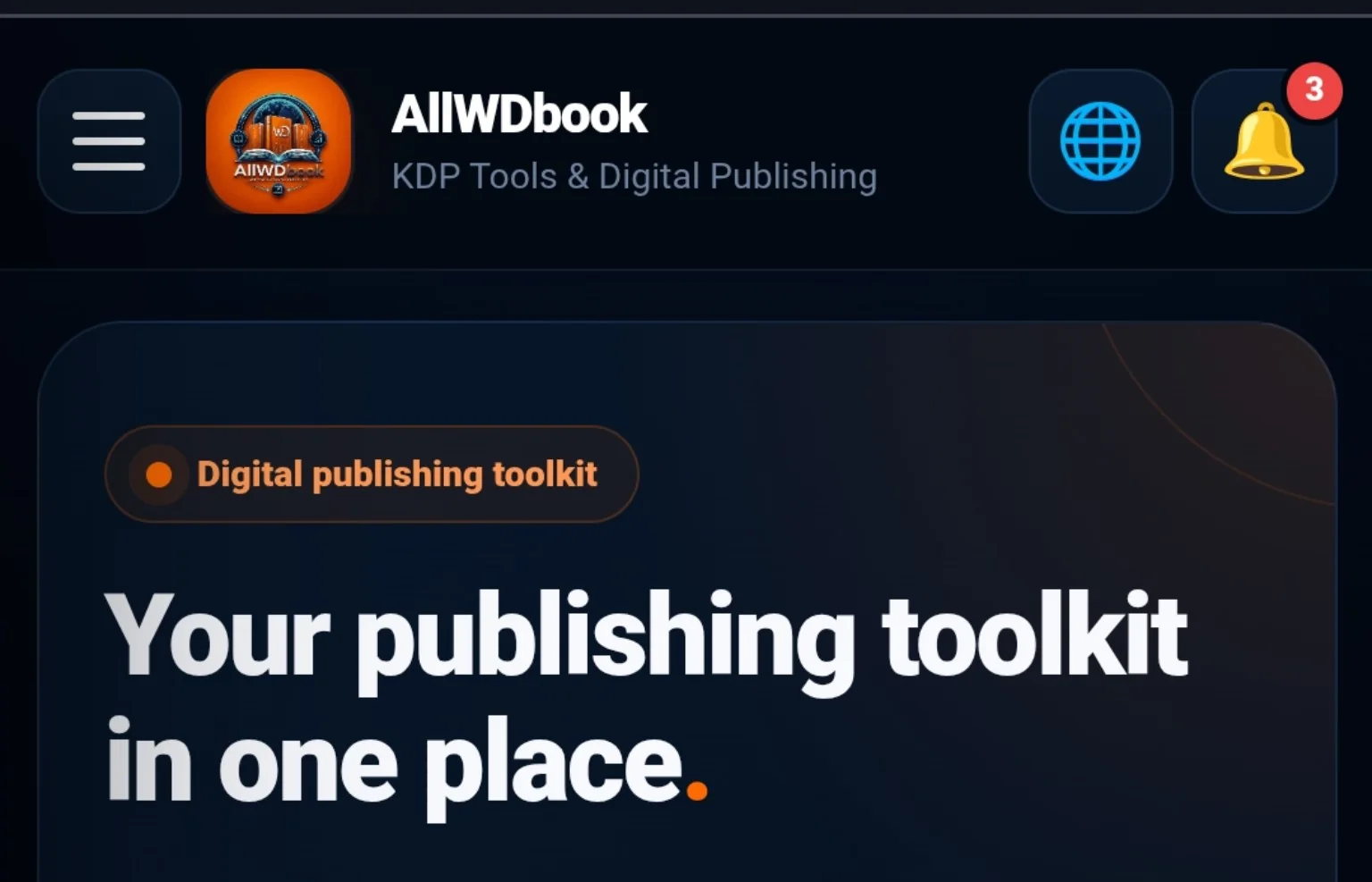
The screenshot used with this article represents that stage of the journey. The homepage is no longer a container for a single utility; it has become the entrance to a broader digital publishing toolkit.
Mobile was not treated as a smaller desktop
During development, it became clear that the mobile experience could not simply be a compressed desktop layout. Many users reach tools from smaller screens, and that changes the priorities of the interface.
Primary controls need enough room to tap, text needs to remain readable, and tools must work without forcing users to zoom or move horizontally across the page.
Mobile-first thinking therefore became part of the development process itself. Before considering an interface finished, it needs to be genuinely usable on a phone, not merely attractive on a large monitor.
That decision influenced the homepage, navigation, individual tools, and even the blog you are reading now.
Building an Arabic and English experience
As AllWDbook moved toward serving a wider audience, language became another part of the product architecture. The requirement was not simply to translate a few buttons, but to make the experience work naturally in Arabic and English.
Arabic requires right-to-left presentation, while English works left-to-right. Navigation, text, headings, and spacing need to remain clear in both directions.
The same principle later shaped the blog. Instead of serving Arabic and English article bodies through one URL that changes language on the client, each language has its own path so the structure is clearer for users and search engines.
Decisions like this add some work at the beginning, but they make the platform much easier to grow as the amount of content and functionality increases.
From something I was building to a real web platform
There is a major difference between a tool working during development and a service that can be opened from a public URL and used every day. That stage introduced a new set of questions: how should updates be deployed, how do we protect the working production version, and how can the platform evolve without breaking stable features?
Using GitHub to manage the project and Vercel for deployment created a clearer development workflow. Changes can be tracked and the production platform can be rebuilt and deployed after updates.
More importantly, this introduced discipline. Once users can open the site at any moment, changes can no longer be treated as isolated experiments. Stable functionality needs to remain stable while new work is added.
At that point, AllWDbook began to feel different from a personal project. It had become a real platform with a production deployment, a domain, tools, content, users, and an ongoing development path.
Reducing friction before users reach value
Another important product question was how many steps a user should be required to complete before reaching the reason they came to AllWDbook in the first place.
It is easy to put mandatory signup forms and passwords in front of every experience. But doing so can create a barrier before a user has even understood the value of the platform.
The direction for AllWDbook was therefore to let people reach the experience without forcing a traditional account at the first step, while still supporting an access system for paid functionality.
This is a useful reminder that product building is not only about adding features. Sometimes a better product comes from removing a step the user did not need.
A real platform is never truly finished
At the beginning, it was easy to imagine a point where the project would simply be finished. Working on a real platform changed that idea.
Every tool can be improved, every interface can become clearer, and real usage exposes details that were not obvious during development. Content also grows, the blog expands, and new needs appear that were not visible in the first version.
I now think about AllWDbook as a product that evolves in stages. That does not mean adding features endlessly. It means repeatedly asking whether the platform can solve the problems it was built for in a better way.
The move from idea to platform did not happen in one moment. It happened through a sequence of small decisions: solve a real problem, build something that works, use it, improve it, and then move to the next problem.
The biggest lesson from the journey so far
The most important lesson from building AllWDbook is that a digital product does not need to begin as something large. It does, however, need a clear reason to exist.
A simple idea can become a real platform when it is connected to a problem the builder understands well and when the solution grows gradually instead of trying to predict everything from the first day.
For AllWDbook, the turning point was not one particular tool. It was realizing that the tools could work together inside one experience built around the publisher's journey.
That is the difference between a collection of features and a product: a product connects its features to a clear purpose and turns them into a coherent experience.