
📚 KDP & Digital Publishing Lab
How to Research KDP Keywords with AllWDbook
A practical workflow for moving from an initial book idea to an organized set of keywords that can be evaluated for a KDP project.
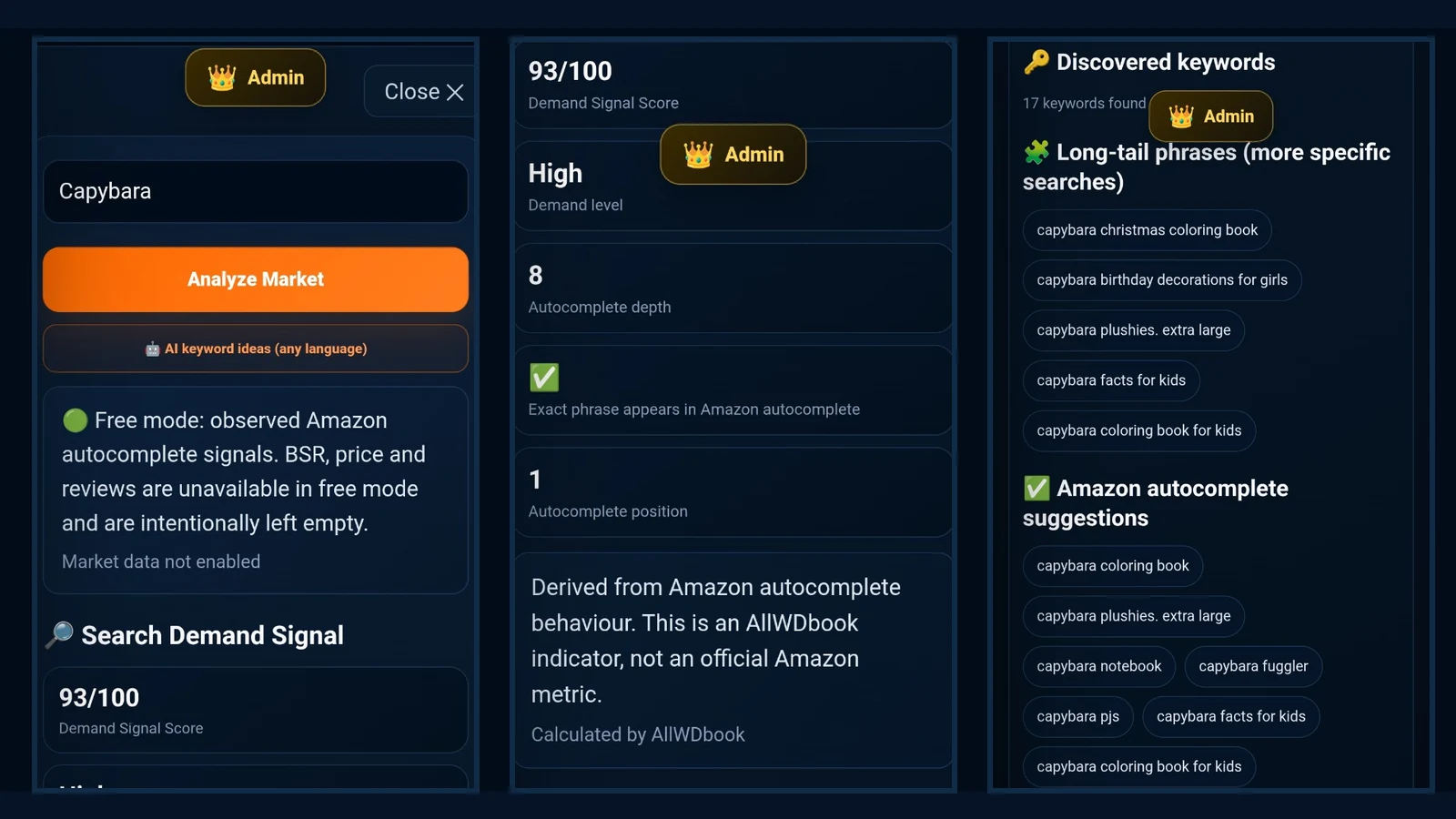
Keyword research for Amazon KDP should not begin with a giant list of phrases. It begins with a simpler question: what phrase describes the book, the reader, or the problem the book is meant to solve?
It is easy to find a keyword that looks interesting and treat it as proof that a publishing opportunity exists. A keyword alone cannot tell us that. We need to understand how closely it matches the book idea, whether it expands into more specific searches, what the surrounding market looks like, and whether the phrase can become part of a structured research path rather than a quick publishing decision.
That is how Keyword Research fits into AllWDbook. You start with a seed phrase, review demand signals when they are available, explore long-tail expansions, examine additional suggestions, and compare market indicators when the data can be measured.
The tool is not designed to say, “publish this book and it will sell.” No research tool can honestly guarantee that. Its purpose is to reduce guesswork, organize research, and give publishers clearer signals that can be combined with human judgment about the market, the product, and the intended reader.
Start with a clear seed keyword, not the broadest possible term
The first step is choosing a seed keyword that describes the core book idea. If you are researching a journal or planner, a phrase that reflects the actual use case is usually more useful than a very broad word such as “journal” or “planner” by itself.
The closer the seed phrase is to the product you are considering, the more useful the next layer of research becomes. A very broad keyword may branch into unrelated directions, while a more focused phrase makes it easier to test whether a coherent opportunity exists around the idea.
You do not need the perfect keyword on the first attempt. Good research is iterative. Start with one phrase, study the signals, notice new directions, and run another analysis on the most relevant one.
How to read the demand signal without turning it into a verdict
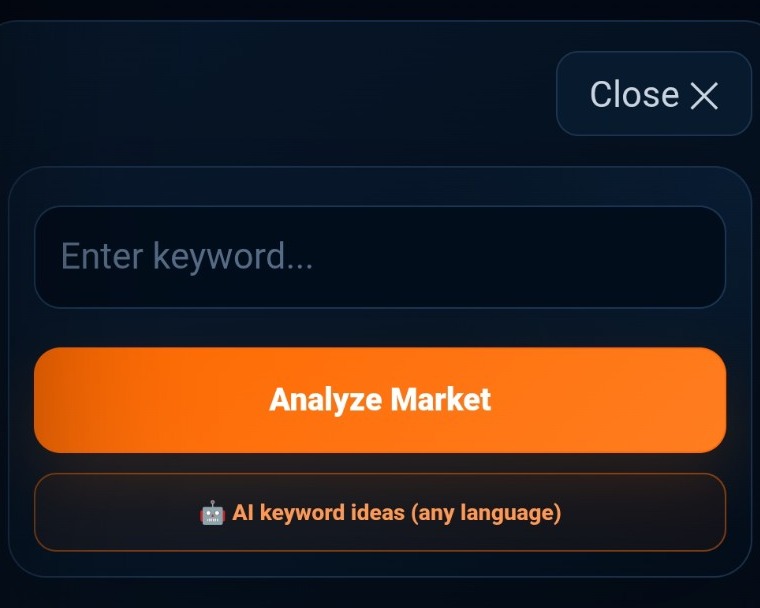
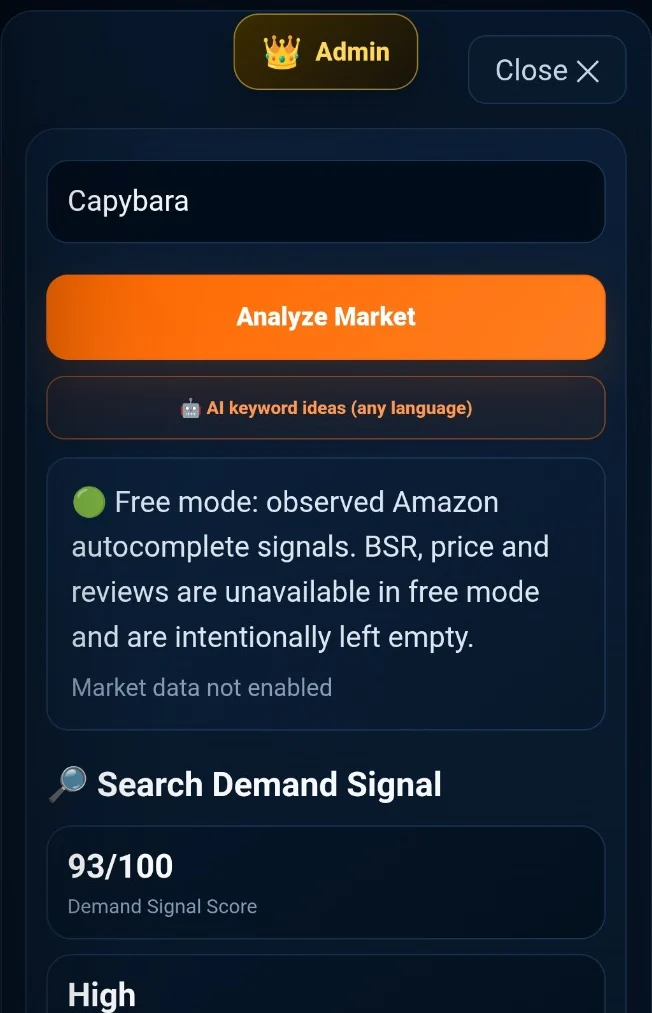
When demand signals are available, AllWDbook can display a Demand Signal Score and a demand level. These are useful research signals, not guaranteed sales forecasts.
Their strongest use is comparison. If you are studying several phrases around the same book idea, the signal can help identify which direction appears to have stronger measurable activity and deserves deeper investigation.
The number should never be used alone. A high-scoring keyword may be too broad or poorly aligned with your book. A narrower phrase may be more relevant to a specific reader even when the overall signal is smaller.
Use the score to decide where to spend your next research minutes, not to automate the publishing decision.
Suggestion depth: does the keyword lead to a real research space?
Suggestion depth can help you understand whether a phrase expands into a meaningful set of related searches.
More suggestions are not automatically better. What matters is the nature of the branches. If they point in completely different directions, the seed may be too broad. If they reveal specific users, problems, or use cases, they can help narrow the niche.
Instead of copying every suggestion, save the phrases that repeat useful patterns or describe a clear use case, then analyze those phrases individually.
Exact match and position: a signal that needs context
The tool can also indicate whether the exact phrase appears in the measured signals and, when available, where that exact match appears.
An exact match can help show how clearly the phrase exists around the market, but it does not mean the keyword is easy or profitable. Position alone does not explain competitor quality, review strength, cover quality, or buyer behavior.
Treat exact match as another piece of evidence. When it aligns with useful expansions, strong relevance to the book, and reasonable market signals, the research hypothesis becomes more worth investigating manually.
Long-tail keywords: moving from a broad topic to clearer intent
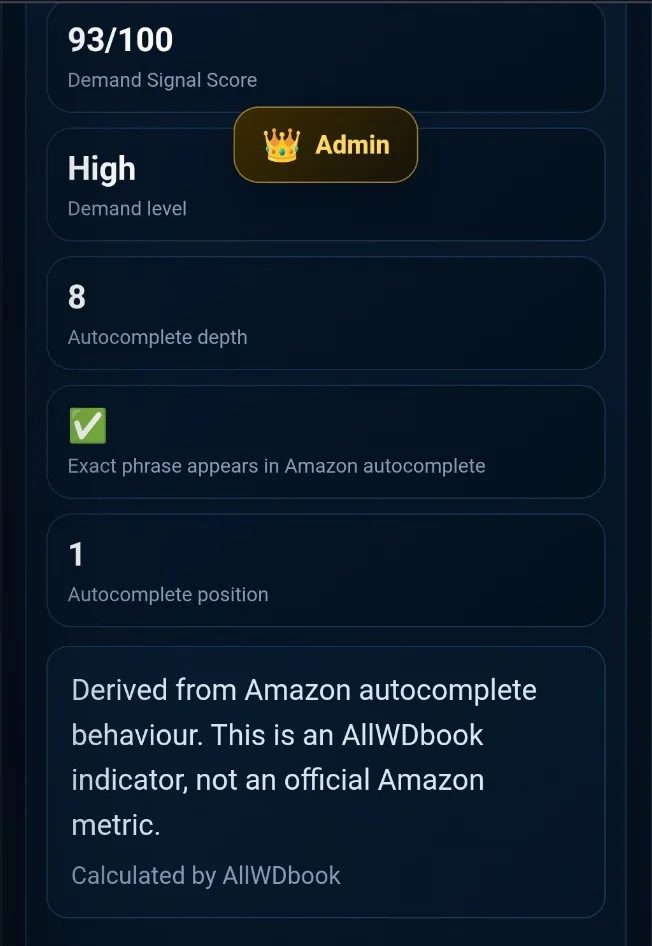
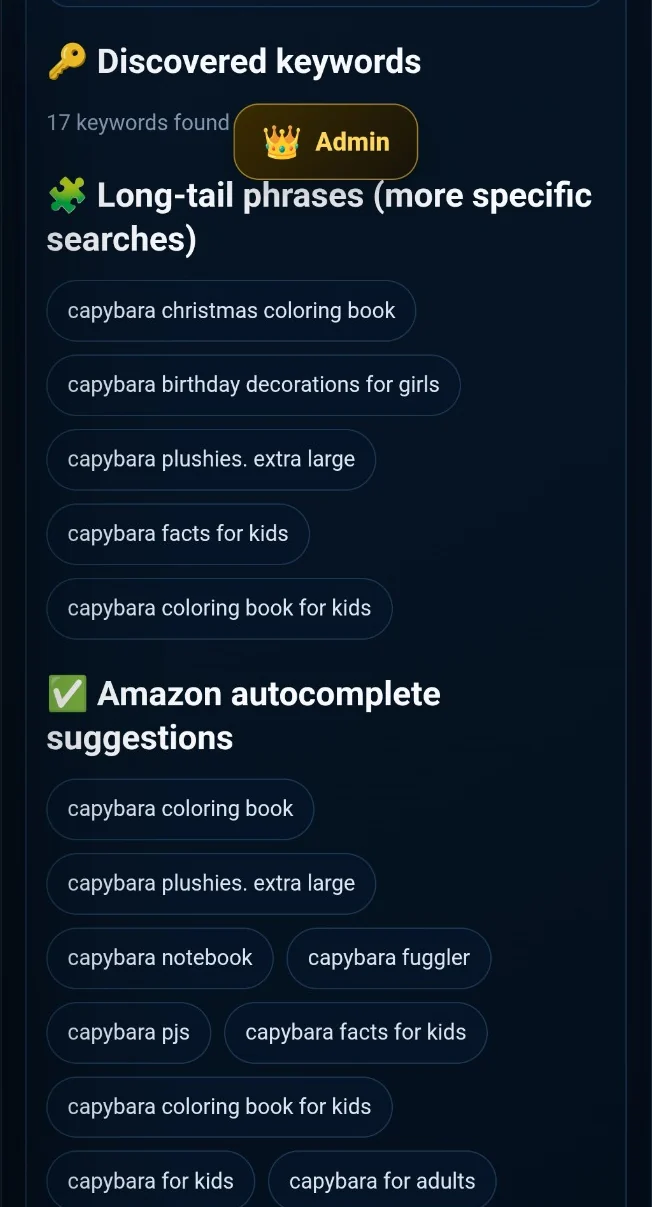
One of the most useful parts of keyword research is moving from a broad phrase toward more specific long-tail keywords. Their value is not simply that they contain more words. They can express a clearer audience, problem, or use case.
A broad topic may expand into phrases connected to an age group, profession, hobby, specific challenge, or format. That is often where a possible micro niche starts to become visible.
In AllWDbook, you can take one of those long-tail directions and analyze it again. The useful loop is Seed Keyword → Long Tail → New Analysis → Narrower Idea.
Use AI suggestions for expansion, not as a replacement for market signals
The tool also includes AI-assisted keyword suggestions. Their main value is idea generation: they can surface language and directions you may not have considered.
An AI suggestion is not evidence of demand. It should be treated as a hypothesis that still needs validation.
A practical method is to select a relevant AI suggestion and run normal keyword analysis on it. AI generates possibilities; market analysis remains a separate verification step.
Market metrics: read averages together with sample size
When market data is available, AllWDbook may show indicators such as average BSR, average price, estimated daily sales, review information, and royalty-related metrics.
Every average needs context. Average BSR is based on a measured sample, so the number of books measured and the confidence level matter. A small sample should not be treated as a complete description of the market.
Price and reviews also need interpretation. A market may have attractive pricing but very strong competitors, or fewer reviews but a poor fit with the type of book you can realistically create.
Use these metrics to compare opportunities, then open the actual Amazon results and manually inspect titles, covers, positioning, and audience before committing to a project.
A practical 7-step workflow inside AllWDbook
1) Enter a seed keyword that clearly describes the book idea. 2) Run the analysis and review Demand Score and Demand Level when available. 3) Check suggestion depth and exact-match signals. 4) Save three to five relevant long-tail phrases.
5) Re-run the strongest long-tail phrases instead of stopping at the first list. 6) Use AI suggestions only to generate additional directions, then verify them. 7) Compare market metrics and visible books, and write down your conclusions before making a publishing decision.
This turns keyword research into gradual narrowing: broad idea → clearer phrases → possible micro niche → research-backed book direction.
Common mistakes that make keyword research less useful
The first mistake is choosing a keyword only because one score is high. The second is forcing every suggestion into the title or description. The third is ignoring the actual Amazon results and relying on a tool alone.
Do not force a book idea into a market that repeatedly gives weak or confusing signals. Sometimes the most valuable research result is realizing that the idea needs to be reframed before you spend time writing and designing.
Good research does not always prove that an idea is excellent. Sometimes it saves time by showing that the idea is not ready yet.
When is a keyword worth moving to the next stage?
For me, a keyword deserves deeper work when several things align: strong relevance to the book, useful long-tail branches, measurable demand signals, understandable market results, and a clear product angle that can serve a real reader.
I am not looking for perfection in every metric. I am looking for a coherent story between the data and the idea. If the number looks good but the search results do not match the book, that is a warning. If the niche is clear but no signals support it, that is also useful information.
The next step is not immediate publishing. You can move into micro-niche analysis, deeper competitor review, book concept development, and then return to keyword research once the product becomes more specific.