
🚀 AllWDbook — From Idea to Launch
AllWDbook Build Journal
Choosing a Payment Provider for AllWDbook: From Lemon Squeezy to Paddle and FastSpring
A real AllWDbook build journey through Lemon Squeezy, Paddle, and FastSpring, including payment freezes, onboarding obstacles, and the search for a stable provider.
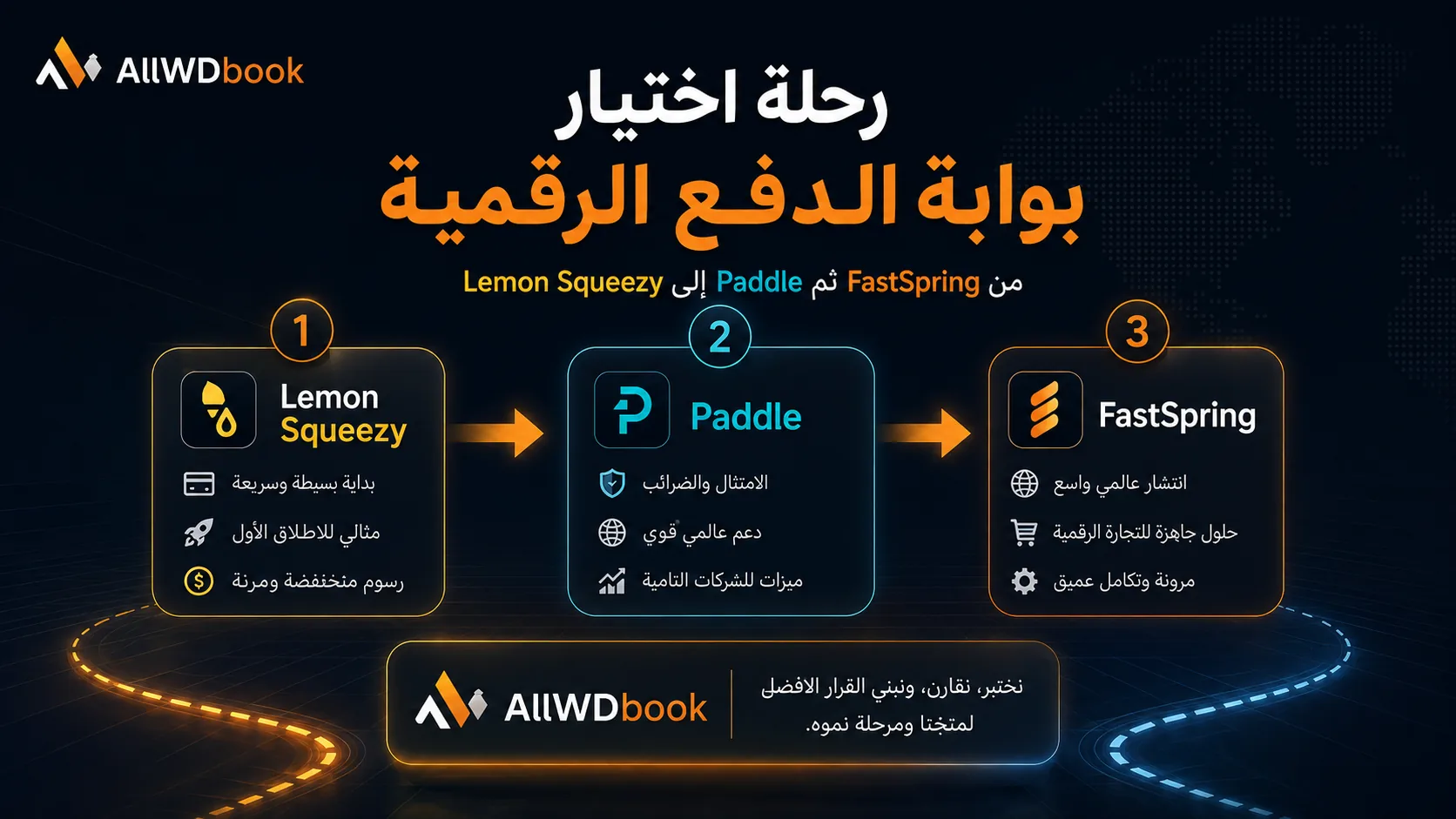
Choosing a payment provider was never a small technical detail in the development of AllWDbook.
When the platform reached the monetization stage, the requirement was larger than adding a button that sends a customer to checkout. We needed a payment provider that could fit the product architecture while preserving the access system that already existed inside AllWDbook.
The journey started with Lemon Squeezy. Later, new payments were intentionally paused while a verification process was unresolved. We then explored Paddle and attempted to begin with its Sandbox environment, but the registration and setup experience did not fit the development path we needed at that stage. The search then moved to FastSpring, where a different obstacle appeared: the initial personal email address was not accepted, so an exception inquiry was submitted and a response was awaited.
This article is not intended to declare one company the best payment provider for everyone. It documents a real AllWDbook development journey and shows how a decision that looks as simple as choosing a payment gateway can affect product architecture, operations, and user experience.
A payment provider is more than a checkout button
From the outside, payment integration can look simple: choose a provider, add a checkout link, and start accepting subscriptions.
Inside a real product, there are additional questions. How is a successful purchase confirmed? How does the application know that access should be granted? What happens when the provider is unavailable? And how do we protect customers who purchased previously if the payment provider changes later?
This mattered particularly for AllWDbook because access was not designed around checkout alone. AWD-KEY, recovery, and existing paid access all needed to continue working even while new payments were paused.
That turned payment-provider selection into an architectural product decision rather than an isolated billing task.
Starting with Lemon Squeezy
Lemon Squeezy was part of the first payment architecture prepared for AllWDbook. The integration connected successful purchases with the platform's access process.
Once a payment system is connected to a real product, it becomes more than an external link. Application workflows depend on its results, and previous customers may have access that must remain valid.
As the project progressed, a verification stage made it inappropriate to continue accepting new payments temporarily.
Rather than trying to work around that process, the safer decision was to pause new payments until the situation became clear.
Pausing payments without pausing the product
Stopping new purchases should not mean shutting down the platform.
AllWDbook therefore separated payment availability from the rest of the product. Free tools continued to work, AWD-KEY remained available, recovery continued to function, and previously granted access was not removed.
This became an important architectural lesson: an external payment provider should not become a single point of failure for the entire product.
If every feature depends directly on the checkout state, a provider problem can affect users who are not trying to purchase anything at all.
Why we did not delete the old Lemon Squeezy integration
When evaluating a replacement provider, deleting the previous integration and starting from zero can look cleaner. For AllWDbook, that would have been the wrong approach.
The existing integration is connected to the history of previous access events. There may be transactions or access keys created while that system was active.
Removing the code simply because a new provider is being considered can make historical access and recovery harder to maintain.
The principle became clear: preserve the old system where it still protects previous customers, while designing any new payment provider primarily for new transactions.
The second stop: exploring Paddle
After new payments were paused, we began evaluating another provider that could be tested before making a production decision.
Paddle was one of the options considered, and the plan was to begin in a Sandbox environment so the integration could be understood without touching real transactions.
However, the registration and Sandbox setup experience did not provide the straightforward development path we needed at that stage. Instead of quickly reaching a test environment, the onboarding process itself became friction.
That led to another useful decision: a project does not need to continue with a provider simply because evaluation has already started. When the setup cost becomes disproportionate to the current need, evaluating another option can be the more efficient choice.
The Sandbox experience is part of the provider evaluation
Payment providers are often compared by pricing or feature lists, but the developer experience begins before the first real payment.
A clear testing path, understandable setup, and a predictable transition from development to production all affect the real cost of integration.
For a small or growing product, developer time is a genuine cost even when it does not appear on an invoice.
The Paddle evaluation reinforced the idea that we are not only choosing a checkout service. We are also choosing the development and maintenance workflow that comes with it.
Moving the evaluation to FastSpring
After the Paddle attempt, the search moved to FastSpring as another option worth evaluating.
This time the first obstacle appeared even earlier. The initial personal email address was not accepted in the inquiry or registration flow, which expected a business-oriented email address.
For an independent digital product, a requirement like this may appear minor, but it can determine whether the founder can even begin the provider relationship.
Instead of stopping there, an exception inquiry was submitted to FastSpring explaining the situation and asking whether the process could continue.
Submitting the exception inquiry and waiting
After the inquiry was submitted, FastSpring displayed confirmation that the request had been received and that the team would follow up.
At that point it would not have made sense to build another payment integration before knowing whether the account could proceed and what the next requirements would be.
New payments therefore remained paused while the rest of AllWDbook continued to operate independently.
This article is being prepared as a build journal during the process. Before final publication, this section will be updated with the actual FastSpring outcome or the next provider decision.
What we actually compare when choosing a payment provider
After going through these stages, it became clear that the comparison cannot be reduced to a single question such as which provider has the lowest fee.
For AllWDbook, the evaluation now includes account onboarding, verification clarity, testing workflow, integration experience, post-payment handling, and how cleanly the provider can connect with the platform's own access system.
User experience also matters. Checkout should feel understandable and connected to the product the customer was already using.
Maintainability matters as well. If plans or access rules change later, the integration should be understandable enough to evolve without rebuilding the product around a payment company.
The most important technical decision: separate payment from access
The most valuable outcome of this journey was not the name of a particular payment company. It was an architectural principle for AllWDbook.
A payment is an event that grants a user a right, but the payment provider should not remain the only place where that right exists.
Once a purchase is confirmed, entitlement can be represented inside the AllWDbook access system, where AWD-KEY, recovery, and other access mechanisms can continue independently from the checkout page.
That separation makes future provider changes safer and helps protect customers from losing access because of external commercial or technical changes.
Why we are not rushing to enable new payments
It is easy to feel that having an active purchase button is more important than waiting, especially after the product itself is already usable.
But accepting payments before the provider, integration, and recovery workflow are properly understood can create larger problems than temporarily missing a few sales.
The priority is for the first purchase after reactivation to be traceable and recoverable, with the customer receiving exactly the access that was promised.
For that reason, payment reactivation remains separate from the ongoing development of tools, content, and user experience. The product can continue improving while the payment layer receives the time required to become stable.
What Lemon Squeezy, Paddle, and FastSpring taught us
Choosing a payment provider is not a competition to find a universally perfect company. It is a process of finding the provider that fits the current product stage, architecture, and customer requirements.
A solution that works extremely well for a large company may introduce unnecessary complexity for an early-stage product, while something that looks easy initially may become less suitable when verification, recovery, and maintenance requirements appear.
Changing direction is not necessarily a failure of planning. It can be the natural result of learning more about the product while building it.
For AllWDbook, this journey will be complete only when new payments can be reactivated with confidence while preserving simple usage and protecting existing access.